Readers considering Colleges in Connecticut can use this profile to review academic options, accreditation, cost, admissions, and learning format. Confirm program availability and requirements directly with the institution because details can change.
An Ivy League school based in New Haven, Yale University is one of the oldest schools in the country and one of the most renowned higher education institutions in the world. Established in 1701, the college educates more than 13,000 students pursuing degrees at the undergraduate, master's, and doctoral levels. Yale has one of the world's highest university endowments, and students take can advantage of top academic programs, an iconic campus, and one of the country's largest college libraries. Yale's undergraduate curriculum follows a liberal arts model, and students can select from dozens of academic majors, such as archaeological studies, environmental engineering, film and media studies, and neuroscience. At the graduate level, Yale offers some of the country's top programs in fields including law, business, nursing, medicine, and engineering.
Headquartered in New Britain, Charter Oak State College exclusively offers online degrees. Students with busy personal or professional lives can pursue a variety of master's, bachelor's completion, associate, and certificate programs. Charter Oak features academic programs in areas such as healthcare administration, childhood development and education, paralegal studies, and cybersecurity. Asynchronous coursework provides learners the ability to complete coursework when it fits their schedule, while select programs offer accelerated five- or eight-week course options. Students may earn additional credits for lifelong learning or prior experience, earned via examination, military training, or the school's portfolio program. Applicants to this best online college in Connecticut must submit a $50 application fee, official transcripts, and test scores. Specific admission requirements vary by degree level and discipline. Out-of-state students pay slightly higher per-credit tuition rates than residents.
Sacred Heart University, the second-largest Catholic university in the state, is committed to truth, justice, service, and intellectual support. Approximately 5,400 students attend each year. In addition to a 300-acre Fairfield campus, this private institution features an e-learning branch with seven online degrees. SHU's online degrees focus primarily on nursing practice, with options available at the bachelor's, master's, and doctoral levels. Current RNs can enroll in a standard RN-to-BSN pathway or combine undergraduate and graduate studies into one RN-BSN-MSN pathway. Master's programs are also available in social work or strategic communication and public relations. Many of SHU's online degrees require in-person clinical practicum hours, but the asynchronous course material can be accessed online 24/7 from any location. Admission procedures and requirements -- including prerequisite education, licensure, minimum GPA, resume, and letters of recommendation -- vary by program selection. All online students pay the same tuition rates, regardless of residency.
Originally a training school for teachers -- with roots going back to 1873 -- Southern Connecticut State University currently boasts an enrollment of approximately 10,000 undergraduate and graduate students. Home to five schools and colleges, SCSU offers degrees in a variety of disciplines, such as earth sciences, healthcare studies, marriage and family therapy, political science, and women's studies. The university also hosts several accelerated bachelor's/master's programs in subjects including athletic training and computer science. As a top state school, SCSU offers many experiential learning opportunities, including study abroad programs and internships. The school maintains more than 30 international partnerships with universities and global education programs, enabling students to travel to countries including Brazil, France, China, Iceland, and Peru. Closer to home, students can participate in internships, fieldwork, and service-learning activities that correspond to their academic and professional interests.
Quinnipiac University is a private liberal arts institution with three campuses located in Hamden and North Haven. Many of the university's 10,000 students also complete classwork in virtual classrooms. The school's full suite of certificates, undergraduate, graduate, and doctoral degrees help make Quinnipiac one of the best online colleges in Connecticut. Twenty-one online degrees and certificates are offered by Quinnipiac's accredited schools of business and law, health sciences, nursing, education, communications, and engineering. Select programs require in-person participation such as clinical or practicum hours. However, many of Quinnipiac's online options -- like the master of science in cybersecurity -- offer a 100% virtual experience. Courses are asynchronous for maximum convenience. Admission requirements vary by program. Before applying, every prospective student is connected with an admissions counselor to discuss individual educational goals and assess program eligibility. All accepted online students receive the same tuition rates, regardless of residency.
Established in 1949, Central Connecticut State University is the oldest public university in the state. Today, the school serves more than 11,000 students, awarding certificates and bachelor's, master's, and doctoral degrees in many fields. Undergraduates can select from dozens of majors and minors, including civil engineering, dance education, graphic technology, and media studies. CCSU also hosts an extensive education program and offers teacher certification pathways in many primary and secondary subjects. The university maintains an active study abroad program that enables participants to spend anywhere from a few weeks to an entire academic year studying in a foreign country. Programs often focus on an issue specific to a country or region. For example, students can explore the impact of volcanoes on the geography and climate in Portugal or the economic and political roots of the Brexit movement in London. Semester- and year-long programs take place at partner colleges in Europe, Asia, Africa, and South America.
A public liberal arts college founded in 1889, Eastern Connecticut State University ranks among the oldest public higher education institutions in the state. The school serves approximately 5,400 students from its main campus in Willimantic -- located about 40 miles east of Hartford -- as well as at a satellite campus in Groton. ECSU offers bachelor's programs in fields including art and art history, environmental earth science, and kinesiology/physical education. Students can also pursue graduate degrees in accounting, education, and organizational management. ECSU recognizes the value of strong writing skills, regardless of a learner's academic concentration. The school's core liberal arts curriculum includes a three-stage writing program that is required for all students entering with fewer than 75 credits. ECSU's writing center also supports student writing through drop-in and scheduled sessions with experienced peer tutors. Online scheduling is also available. The university also offers opportunity programs to enhance the chances of academic success for first-generation, low-income, undocumented, and other student populations.
A public institution composed of five academic colleges and divisions (i.e., business, arts and science, professional studies, visual and performing arts, graduate studies), Western Connecticut State University serves about 5,400 students through its undergraduate and graduate programs. The school's undergraduate offerings include music, meteorology, professional writing, and anthropology, while graduate options include health administration, addiction studies, and nursing. WCSU hosts an online master's program in applied behavior analysis, along with many online courses at the undergraduate and graduate levels. The school also offers in-state tuition to undergraduate residents of New York and New Jersey who enroll on a full-time basis. All students can access extensive academic tutoring services, available through the school's tutoring resource center and writing center. For current and former members of the military, WCSU's Veterans Affairs Office provides an array of resources and benefits, including tuition waivers and academic credit for military service.
Albertus Magnus College, a private Catholic liberal arts college based in New Haven, has designed innovative, accelerated courses for working adults since 1985. That tradition continues today with a variety of flexible associate and bachelor's degrees available in online and hybrid formats. Albertus offers academic programs in the arts and sciences, business and leadership, and social sciences. Many online programs offer accelerated schedules (six- or eight-week classes and two courses per term) that allow students to earn approximately 30 credits each year. Other available degrees include a master of science in clinical counseling, a master of fine arts in writing, and an MBA with six specialization options. Prospective Albertus students should submit an online application, college transcripts, photo identification, and a $35-$50 fee. Additional admission requirements may apply depending on program selection. State residency does not impact online students' tuition rates.
A private school based in West Haven and bordering the Long Island Sound, the University of New Haven serves approximately 7,000 students. Focusing on the intersection of liberal arts and professional training, New Haven comprises six academic schools and colleges, with top-rated programs in engineering, forensic science, criminal justice, and marine biology. The school offers bachelor's, master's, and doctoral programs. New Haven also hosts a selection of fully online programs available to students across the U.S. Distance learners can enroll in an undergraduate program in homeland security and emergency management and graduate programs in criminal justice, emergency management, environmental engineering, investigations, and public administration. Most online courses use a primarily asynchronous format with few required login times, enabling students to complete assignments at their convenience.
One of the country's top liberal arts colleges, Wesleyan University serves approximately 3,200 students from its campus in Middletown. As a baccalaureate college, Wesleyan focuses on undergraduate education in the arts and sciences, though the school does host a selection of master's and doctoral programs. The college ranks among the most selective in the country and boasts many successful alumni, including Pulitzer Prize winners, Rhodes scholars, and MacArthur fellows. Students at Wesleyan can select from a variety of liberal arts majors and minors, including American studies, earth and environmental sciences, gender and sexuality studies, philosophy, and theater. The school's graduate programs primarily focus on math and sciences, including options in chemistry, biology, astronomy, and computer science. Wesleyan also offers a graduate-level liberal studies program with concentration options that include history, writing, and fine arts.
The University of Bridgeport is a private nonsectarian institution that serves more than 5,000 students on campus and online each year. UB launched its first online degree -- a master of science in human nutrition -- in 1997. UB's online and hybrid catalog now includes eleven other programs, including five bachelor's degrees, four master's degrees, and two doctoral degrees in educational leadership and health sciences. The school also features a bachelor of science in dental hygiene. Offered by the world's first-established school of dental hygiene, this program accepts up to 90 transfer credits and prepares licensed dental hygienists for advanced career opportunities in as little as two years. Specific admission procedures and requirements vary for undergraduates and graduates, but all applicants must submit relevant transcripts, letters of recommendation, and a $25-$50 fee. do -- include healthcare, business, and computer systems. Software developers and registered nurses rank among the top 10 occupations as measured by job ads, while half of the top 10 employers placing job ads in the state are healthcare companies like UC Health. While finding the right school can be a challenge, these rankings review some of the best online colleges in Colorado. Our guide outlines each accredited school’s campuses, online program offerings, and admissions criteria to help you find an online program that meets your budget, schedule, and career goals.
Based in Storrs -- about 30 miles outside of Hartford -- the University of Connecticut ranks as the largest college in the state, enrolling more than 32,000 students annually through campus-based and online courses. As the state's flagship public university, UConn offers more than 110 majors in its 14 schools and colleges, with degrees available at all academic levels. The school hosts many top-ranked professional and academic programs, including education, primary care medicine, pharmacy, social work, and speech-language pathology. As a major public research university, UConn offers substantial opportunities for undergraduates to participate in faculty research. The school's Office of Undergraduate Research connects students to mentorships, research seminars, workshops, funding opportunities, and other resources for independent and collaborative research. In 2018, UConn received over $250 million in support for research, training, and public service and provided nearly $200 million in scholarships and grants to its students.
A small liberal arts college founded in 1911, Connecticut College provides undergraduate instruction to approximately 1,800 students annually. The school's small size allows for a highly individualized student experience; Conn boasts a student-to-faculty ratio of 9-to-1 and an average class size of just 18 learners. Students can choose from majors in over 50 areas of study, including anthropology, art history, film studies, and Hispanic studies. Conn emphasizes a global approach to education, with more than half of all students participating in study abroad experiences. During their junior or senior year, students have the opportunity to examine a community issue in a foreign country, completing a college-funded internship as part of their experience. Candidates who choose not to study abroad complete a funded internship in the U.S., either in New London or another location. A selective institution, Conn admits only 10% of all applicants. Ninety-two percent of incoming first-year students ranked in the top 20% of their high school graduating class.
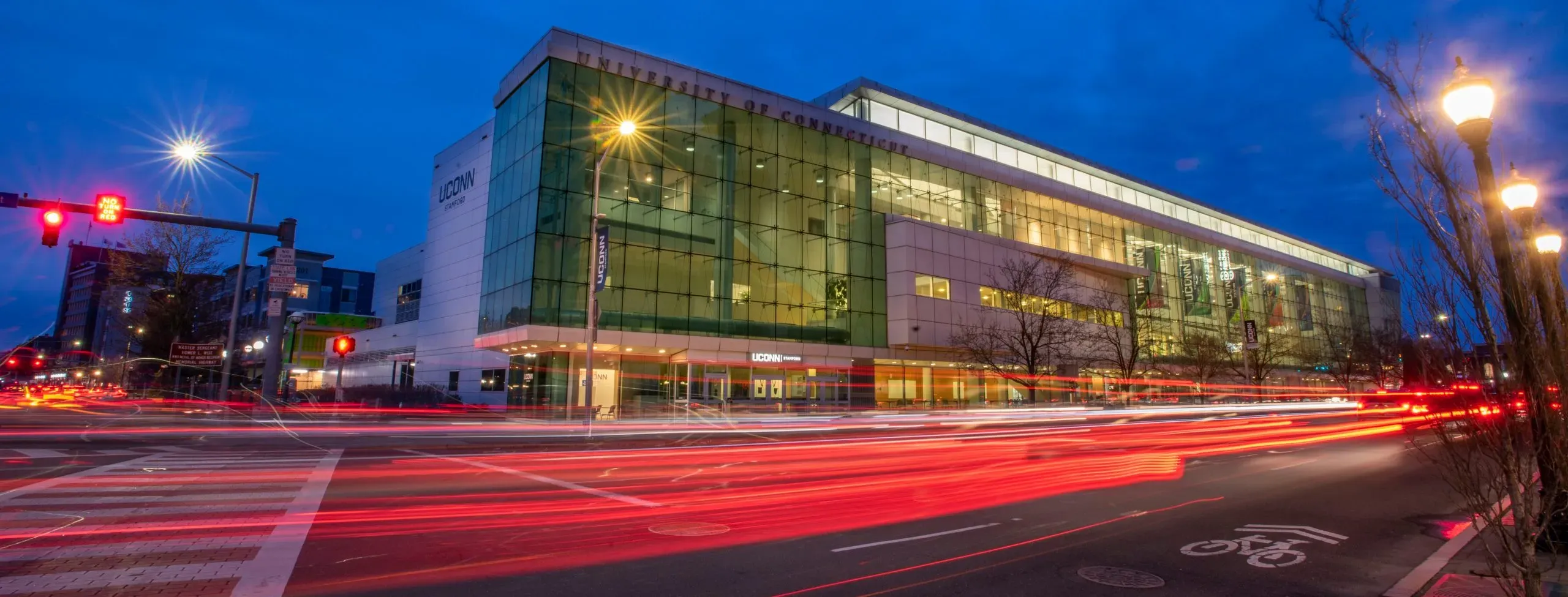
Founded in 1952 as an extension center for the main University of Connecticut campus at Storrs, the University of Connecticut - Stamford now enrolls more than 2,000 students annually. The school primarily serves undergraduate learners, offering majors in fields like business, computer science, digital media and design, human development and family studies, and political science. UConn Stamford also awards a selection of graduate business degrees, including an MBA, an MS in financial risk management, and an MS in business analytics and project management. Though UConn Stamford's campus is small, the school offers several academic and counseling resources to help students navigate college life and increase retention rates. For example, the Center for Academic Programs assists first-generation college students and those from underrepresented populations through degree planning and career counseling. Additionally, the Source for Active Learning offers tutoring in subjects including writing, math, science, ESL, and even financial literacy, with campus-based and online assistance available.
A private Jesuit college, Fairfield University provides higher education to more than 5,000 students through bachelor's, master's, and doctoral programs. Fairfield is home to five schools and colleges, including business, arts and sciences, nursing and health studies, education and allied professions, and engineering. Students can choose from more than 60 undergraduate majors and minors and more than 40 graduate programs. The school also offers three online/hybrid graduate degrees: creative writing, education technology, and social work. Fairfield emphasizes the value of experiential learning, and most undergraduates participate in internships, service learning, or similar activities and projects. The school's Career Planning office assists students at all levels with placement opportunities; Fairfield students have interned with major organizations such as Disney, NBC, Yale New Haven Health, Ralph Lauren, and the NFL. For professionals wishing to gain new skills or fulfill continuing education requirements, the Executive and Professional Education Center offers noncredit certificates at the undergraduate and graduate levels.
A regional campus of the UConn system, the University of Connecticut - Waterbury provides bachelor's, master's, and transfer degree programs to a population of approximately 850 students. The school primarily serves undergraduates through bachelor's programs in subjects like American studies, business data analytics, English, human development and sciences, and urban and community studies. UConn Waterbury also offers two graduate degrees: a master of business administration and a master of engineering. UConn Waterbury's transfer programs allow students to complete the first half of their undergraduate studies (typically 54 credits) locally before transferring to UConn's main campus to finish their remaining coursework. Candidates can select from nearly all of UConn's 100-plus undergraduate majors. However, some degrees -- such as maritime science and digital marketing -- require additional studies on other campuses. The school also maintains a secondary-level teacher certification program and a nursing program for professionals with a non-nursing bachelor's who wish to enter the field and qualify to take the National Council Licensure Examination.
Located in Groton and surrounded on three sides by the Connecticut coast, the University of Connecticut - Avery Point is a small school with an enrollment of approximately 500 students. Like its regional counterparts, UConn Avery Point primarily serves as a transfer institution, enabling undergraduates to complete the first half of a bachelor's degree locally before transferring to the main UConn campus in Storrs. The college's coastal location offers unique opportunities for study and research, and the school features notable undergraduate programs in maritime sciences and maritime studies, as well as a graduate program in oceanography. These three programs benefit from several campus facilities, including the Connecticut Institute for Resilience and Climate Adaption and the Mystic Aquarium Research Labs. UConn Avery Point also offers bachelor's programs in American studies, English, and general studies, as well as graduate tracks in engineering, nursing, and teaching.
Use Best Colleges in Connecticut to build a shortlist, then ask every college the same questions about accreditation, program availability, total cost, transfer credit, course scheduling, advising, and completion support. Request answers in writing when they could affect the time or money required to graduate.
Compare Evidence, Not Labels
Read the current catalog and official consumer disclosures. Check whether broad institutional statistics actually describe the program and study format you are considering. A familiar name or favorable ranking does not establish academic, financial, or career fit for an individual student.
Verify Before Enrolling
Confirm the final cost estimate, financial-aid conditions, refund rules, transfer evaluation, and any state authorization or professional licensing requirements. Save copies of the materials that informed your decision.

 New Haven, CT
 $18053
 97%
97%